
Just in case you’re getting your list ready on what to get your Tumblr pals, I want two books for Christmas. The first is the new Neil Young book, Waging Heavy Peace and Morrissey’s “Autobiography”.
Go get it.


A Little Boy Lost
``Nought loves another as itself,
Nor venerates another so,
Nor is it possible to Thought
A greater than itself to know:
``And Father, how can I love you
Or any of my brothers more?
I love you like the little bird
That picks up crumbs around the door.''
The Priest sat by and heard the child,
In trembling zeal he siez'd his hair:
He led him by his little coat,
And all admir'd the Priestly care.
And standing on the altar high,
``Lo! what a fiend is here!'' said he,
``One who sets reason up for judge
Of our most holy Mystery.''
The weeping child could not be heard,
The weeping parents wept in vain;
They strip'd him to his little shirt,
And bound him in an iron chain;
And burn'd him in a holy place,
Where many had been burn'd before:
The weeping parents wept in vain.
Are such things done on Albion's shore?
The Little Girl Lost
In futurity
I prophetic see
That the earth from sleep
(Grave the sentence deep)
Shall arise and seek
For her maker meek;
And in the desart wild
Become a garden mild.
* * *
In the southern clime,
Where the summer's prime
Never fades away,
Lovely Lyca lay.
Seven summers old
Lovely Lyca told;
She had wander'd long
Hearing wild birds' song.
``Sweet sleep, come to me
Underneath this tree.
Do father, mother weep,
Where can Lyca sleep?
``Lost in desart wild
Is your little child.
How can Lyca sleep
If her mother weep?
``If her heart does ake
Then let Lyca wake;
If my mother sleep,
Lyca shall not weep.
``Frowning, frowning night,
O'er this desart bright
Let thy moon arise
While I close my eyes.''
Sleeping Lyca lay
While the beasts of prey,
Come from caverns deep,
View'd the maid asleep.
The kingly lion stood
And the virgin view'd,
Then he gamboll'd round
O'er the hollow'd ground.
Leopards, tygers, play
Round her as she lay,
While the lion old
Bow'd his mane of gold.
And her bosom lick,
And upon her neck
From his eyes of flame
Ruby tears there came;
While the lioness
Loos'd her slender dress,
And naked they convey'd
To caves the sleeping maid.

 Reading and Brahms Tonight. Before some television time with the cast of Modern Family. The only time of week where I plump myself in front of the boob tube and laugh out loud at a television sitcom. It feels great. After, I will lock myself up in my room. Turn off the big lights. Turn on my reading lights and enjoy some quiet time listening to classical music and catching up on a book I'm reading. Urban Nightmares. I read it before, but I thought I would take another glance at it. It's a great book if you're into the whole lawless immorality and crime of the 1990s thing. Soft stuff. Really. Today I got by. I felt sweat itching off my forehead. Headache creeping in, but I handled it. I took a breather. Stood back and realized the now. Wondering what needed to be done and took charge of it. I don't know. Maybe this little sober streak I've been on, I've been more at touch with my subconsciousness and cluing in to what I am about to think and stopping myself from letting in negativity. Any of that makes sense? It did in my head. I even reunited with my acupressure mat the other day. We haven't talked in a while.

 Genius, hermit and sexual predator: Novelist J.D.Salinger was also the ultimate anti-celebrity
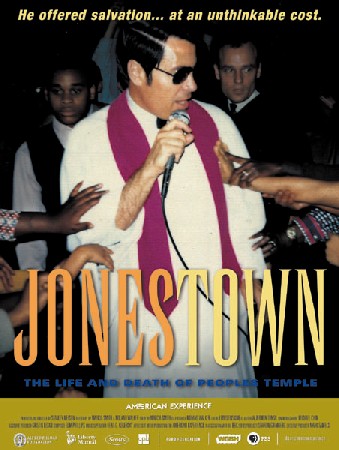
Produced for the PBS series American Experience, Stanley Nelson’s Jonestown: The Life and Death of the Peoples’ Temple, written by his frequent collaborator Marcia Smith, examines the infamous religious cult formed by Jim Jones and the events that led to the group’s horrifying mass suicide in 1978. The film traces Jones’ history from his unhappy childhood in rural Indiana.
Witnesses describe a strange, charismatic young man who nursed a seemingly sincere desire for social justice, but also reputedly murdered small animals as a child. Jones’ desire to befriend people across color and class lines alienated his family and neighbors. Eventually, he moved to Indianapolis, where, as a young Pentecostal minister, he started the city’s first integrated church.
Eventually, Jones moved his church to California to escape the racism he perceived in Indiana. In Redwood Valley, his church took on a new life, and he began aggressively recruiting new members. At first, members were required to tithe a percentage of their worth, but eventually, they were expected to relinquish all of their “worldly goods” to the Temple. In 1974, Jones moved to San Francisco, where he acquired some political clout before his high profile caught up with him.
Just before a damaging exposé was published, he moved his people to what was meant to be a “paradise” outside the racism and oppression of America, in Guyana. Nelson interviews eyewitnesses, including many former members of the Temple, and members of Congressman Leo Ryan’s staff who managed to escape when the congressman’s investigatory visit ended in bloodshed. The film had its world premiere at the 2006 Tribeca Film Festival.

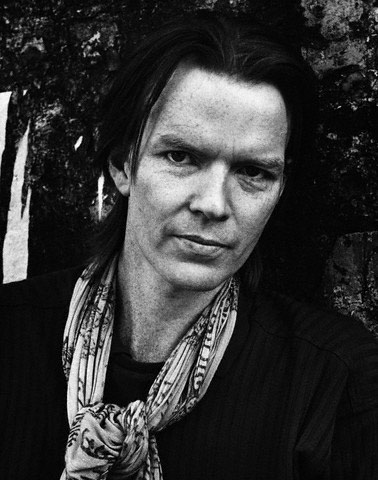
POET and musician Jim Carroll, who chronicled his teenage drug use in The Basketball Diaries, has died in New York at age 60.
In the 1970s, Carroll was a fixture of the burgeoning downtown New York art scene, where he mixed with artists such as Andy Warhol, Patti Smith, Larry Rivers and Robert Mapplethorpe. His life was shaped by drug use, which he wrote about extensively.
The son of a bar owner, Carroll attended Trinity, an elite private school on Manhattan's Upper West Side, on a basketball scholarship. He excelled at sport but from the age of 13 was leading a double life.
He experimented with heroin and supported his addiction by hustling gay men; he wrote about these experiences in The Basketball Diaries.
The book, which began life as a journal, was first published in 1978 and became particularly popular on university campuses when it was issued as a mass-market paperback two years later. A 1995 movie version starred Leonardo DiCaprio and Mark Wahlberg.
Carroll's poetry career started even earlier. He was in his teens when he first received recognition for his poems, especially Organic Trains in 1967, then 4 Ups and 1 Down in 1970.
It was his raw and fiery poetry, in verse form and in his lyrics for the Jim Carroll Band, that quickly earned him a reputation as a new Bob Dylan.
"I met him in 1970 and already he was pretty much universally recognised as the best poet of his generation," singer and poet Patti Smith told The New York Times.
"The work was sophisticated and elegant. He had beauty."
Carroll spent time with and around some of the most acclaimed poets, musicians and other artists of his and other generations: Smith, Rolling Stones guitarist Keith Richards, and beat poet Allen Ginsberg, who lauded the younger man's poetry and occasionally performed with him.
In the 1970s Carroll worked with Warhol at his famous Factory and contributed to the pop artist's films, collaborated with the likes of Lou Reed and lived for a period with Smith and Mapplethorpe.
In music Carroll had an outsized influence on underground rock and punk, and his 1980 album Catholic Boy is considered a punk classic. The album's biggest hit, People Who Died, was a litany of his friends who had passed away, many of drug overdoses or murder, and was featured on the soundtrack to the Steven Spielberg blockbuster ET: The Extra-Terrestrial.
Carroll's former wife Rosemary Carroll told The New York Times he died on Friday of a heart attack.


